
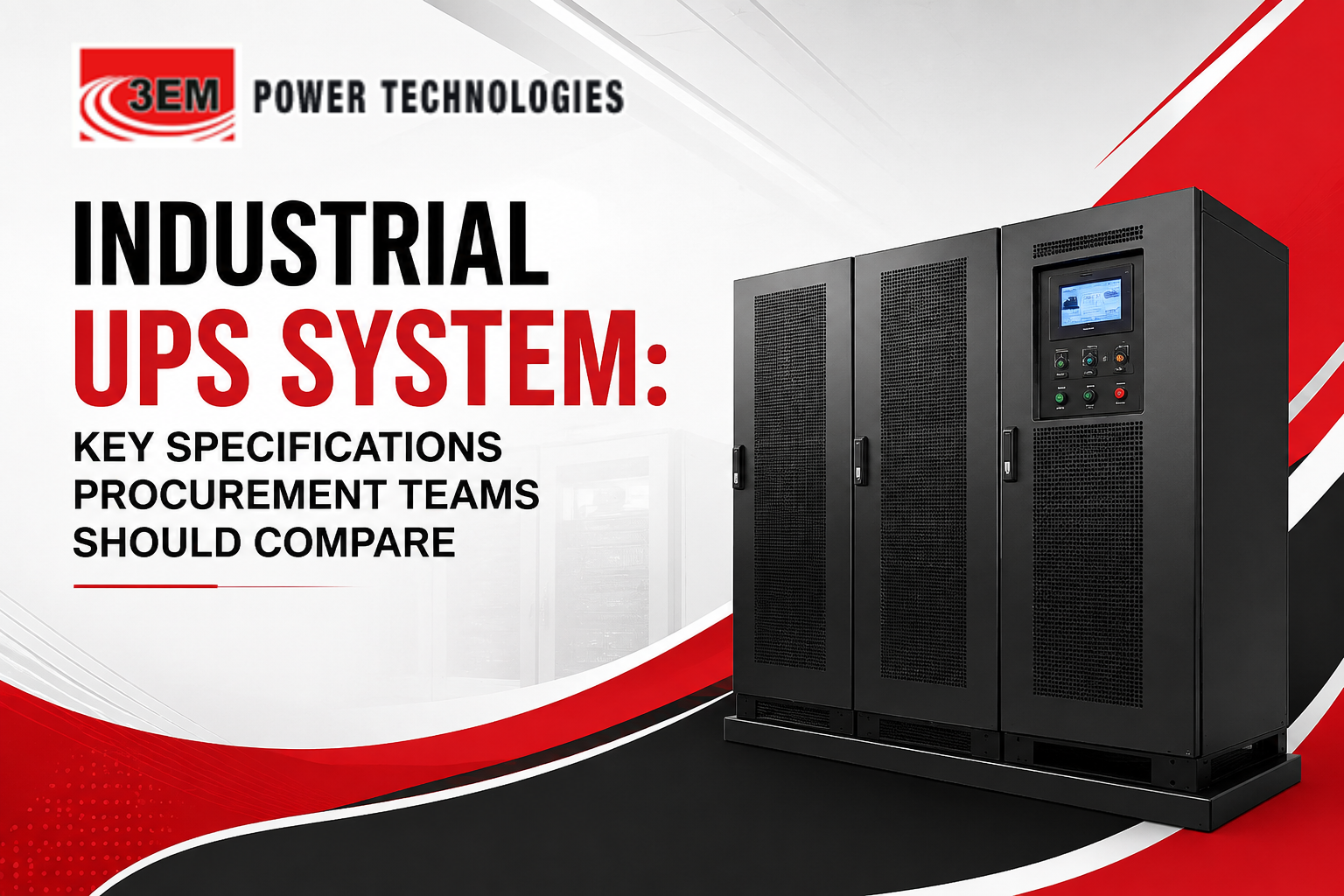
Choosing an Industrial UPS System involves much more than price and power comparisons. The procurement team needs to consider important specifications that impact protection, performance, and durability.
Industrial UPS Systems supplied by 3EM Power Technologies Pvt. Ltd can handle critical loads including PLCs, control panels, automation systems, servers, and communication networks. Below are some of the important specifications you need to consider.
Key Specifications Procurement Teams Should Consider While Comparing
1. UPS Capacity and Load Requirement
UPS capacity is measured in kVA or kW. Compare the system according to:
- Current load requirement
- Power factor
- Future expansion needs
- Required operating margin
The UPS should be properly sized to handle the load without unnecessary oversizing.
2. UPS Topology and Power Quality
For critical industrial applications, power quality is essential. Compare:
- Input voltage range
- Output voltage regulation
- Frequency accuracy
- Transfer time
- Total harmonic distortion (THD)
An online UPS system can provide continuous and stable power for sensitive industrial equipment.
3. Battery Backup and Battery Type
Backup requirements vary depending on whether the UPS needs to support operations until generator startup or enable a safe shutdown.
Check:
- Backup time at actual load
- Battery technology
- Battery life
- Charging time
- Battery monitoring features
3EM Power Technologies Pvt. Ltd says that – “always compare runtime based on the actual connected load rather than the maximum claimed backup time.”
4. Overload and Protection Capability
Industrial environments can experience sudden load changes and electrical disturbances. Important specifications include:
- Overload capacity
- Short-circuit protection
- Surge protection
- Overvoltage and undervoltage protection
- Automatic or manual bypass
These features help protect both the UPS and connected equipment.
5. Input Power Compatibility
The UPS should perform reliably under varying industrial power conditions. Compare its:
- Input voltage tolerance
- Frequency range
- Generator compatibility
- Harmonic performance
- Ability to handle voltage fluctuations
This is particularly important in facilities with unstable grid power.
6. Efficiency and Operating Cost
Procurement decisions should consider the total cost of ownership, not just the purchase price. Evaluate:
- UPS efficiency
- Energy consumption
- Battery replacement costs
- Maintenance requirements
- Availability of spare parts
A high-efficiency Industrial UPS System can help reduce long-term operating expenses.
7. Monitoring and Remote Management
Modern UPS systems offer monitoring features that support proactive maintenance. Look for:
- LCD/HMI display
- Remote monitoring
- Alarm notifications
- Event logs
- Battery health monitoring
- System communication options
These features help maintenance teams identify potential issues before they cause downtime.
8. Manufacturer Support and Reliability
Finally, evaluate the manufacturer’s technical expertise and after-sales capabilities. Reliable support for installation, commissioning, maintenance, and service is essential for critical industrial applications.
Best Industrial UPS System – 3EM Power Technologies Pvt. Ltd
The correct Industrial UPS System is one that caters to all the needs of your load, backup, and power requirements and operations as well. It is possible to make an economical decision after comparing all these factors against 3EM Power Technologies Pvt. Ltd.
Frequently Asked Questions:
1. What is an Industrial UPS System?
An Industrial UPS System provides uninterrupted and stable power to critical industrial equipment during power failures or fluctuations.
2. How do I select the right UPS capacity?
Calculate the total connected load, power factor, and future expansion requirements before selecting the UPS capacity.
3. Why is battery backup time important?
It determines how long critical equipment can operate during a power outage or until backup power takes over.
4. What UPS topology is suitable for industrial applications?
Online double-conversion UPS systems are commonly preferred for critical applications requiring continuous and stable power.
5. Should procurement teams consider UPS efficiency?
Yes. Higher efficiency can reduce energy consumption and lower the overall operating cost of the UPS system.